
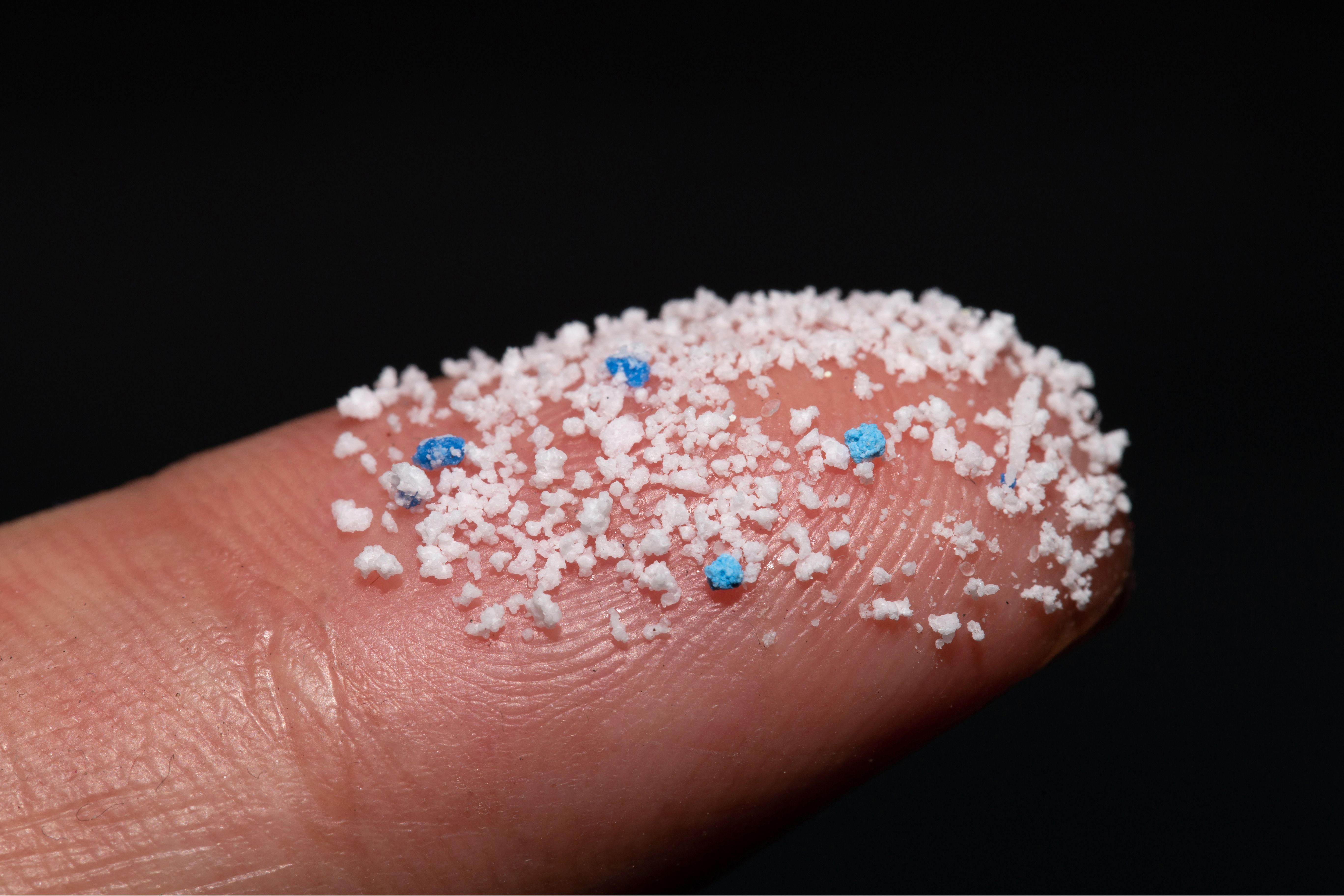
For many years, plastic pollution was largely seen as an environmental issue. Images of ocean waste and plastic-covered beaches helped the world understand the scale of the problem.
But in recent years, the conversation has begun to shift. Scientists are increasingly detecting microplastics in the human body, including in lungs, organs and even microplastics in human blood.
Research into microplastics is still developing, but studies have already reported the presence of plastic particles in blood samples and human tissue. In some cases, microplastics have even been detected in placentas, raising new questions about how these particles move through the body (PubMed).
At Notpla, where our mission is to replace single-use plastic packaging with natural materials such as seaweed, this research raises an important question:
Are microplastics already present in our own bloodstream?
To explore that question, Notpla co-founder Pierre Paslier and Head of Impact Hoa Nguyen decided to take part in a microplastics blood test.
Microplastics are tiny fragments of plastic typically smaller than five millimetres. They form when larger plastic products break down through sunlight, friction and environmental degradation.
Over time these fragments can become even smaller particles known as nanoplastics, which are small enough to travel through air, water and biological systems.
Because plastic is used across almost every industry, from food packaging to textiles and consumer goods, microplastics are now found across ecosystems worldwide. Scientists have detected them in oceans, rivers, soil and even atmospheric dust.
More recently, researchers have begun detecting microplastics in the human body.
One widely cited estimate suggests humans may ingest or inhale around five grams of microplastics per week, roughly the weight of a credit card (WWF). While the exact amount remains debated among scientists, the estimate highlights just how widespread plastic exposure may be.
To better understand how microplastics in human blood might appear, Pierre and Hoa took part in a test designed to detect microscopic plastic particles in blood samples.
The process involves analysing a small amount of blood to identify the number of plastic particles present per millilitre of blood.
Before receiving the results, both had their own expectations.
Pierre has spent years researching plastic pollution and actively tries to reduce plastic exposure in everyday life. He avoids heating food in plastic containers and limits the use of plastic packaging where possible.
Hoa, who grew up in Vietnam where plastic packaging is widely used in food storage and retail, suspected her exposure might be higher.
Despite these assumptions, neither knew what the test would reveal.
When the results came back, the difference between them was striking.
Pierre’s test detected 20 microplastic particles per millilitre of blood.
Hoa’s test detected 200 particles per millilitre.
When extrapolated across the body, this represents roughly 100,000 microplastic particles in one case and nearly one million in the other.
The numbers themselves were surprising, but what stood out most was the difference between the two results. Even among individuals working closely on plastic pollution, microplastic exposure can vary significantly.
This highlights how many factors, from lifestyle choices to environmental exposure, may influence the amount of plastic particles in the human body.
Scientists believe microplastics enter the body through several pathways.
One route is inhalation, as tiny plastic particles can become airborne and enter the lungs. Another is ingestion, as microplastics have been detected in drinking water, seafood and other foods.
Researchers are also investigating how microplastics from food packaging may migrate into food over time, particularly when plastics are heated or used for long-term storage.
In addition to the particles themselves, many plastics contain chemical additives such as plasticisers, stabilisers and flame retardants. Scientists are now studying how microplastics may act not only as particles but also as carriers for plastic chemicals inside the body.
Understanding these exposure pathways is still an active area of microplastics research.
The study of microplastics and human health is still relatively new, but scientific interest is growing rapidly.
Researchers have now detected microplastics in organs and human tissues, including:
Each study helps scientists better understand how plastic particles move through the body and interact with biological systems.
Testing methods are still evolving, meaning measurements may become more precise as research develops. However, across this growing body of studies, the presence of microplastics in the human body is becoming increasingly well documented.
At Notpla, our work began with a simple idea: replacing plastic packaging with materials that work with nature rather than against it.
Originally, the focus was on reducing plastic waste entering the environment. But the growing research around microplastics in the human body highlights a broader issue.
The materials we design today do not only affect ecosystems. They also influence what enters our food systems and potentially our bodies.
Developing packaging made from natural materials such as seaweed is one way to rethink the role materials play in everyday products.
By reducing reliance on conventional plastics, we can help limit the plastic particles entering our environment and food systems.
Testing two people’s blood will not solve the microplastics problem, but it does make something abstract suddenly feel very real.
As scientific tools improve, researchers will gain a clearer understanding of how microplastics move through ecosystems and the human body.
At the same time, industries will continue developing materials designed to reduce reliance on conventional plastics.
Awareness is only the first step.
But understanding how plastic particles move through our world, and potentially through our bodies, is an important part of building better solutions.
.jpg) Bespoke packaging at Notpla: Meet the team behind our food packaging design process
Bespoke packaging at Notpla: Meet the team behind our food packaging design process.jpg) The end of plastic versus paper: Why natural materials belong in modern manufacturing
The end of plastic versus paper: Why natural materials belong in modern manufacturing Notpla Stadium Range: building sustainable packaging into the big-game experience, at scale with Levy.